

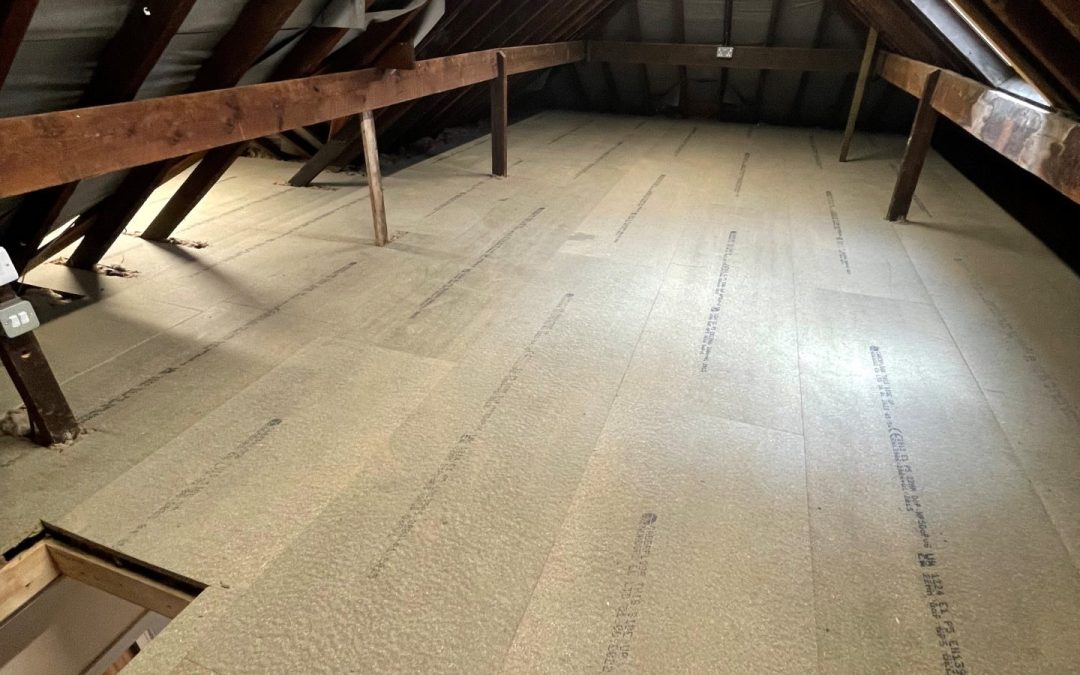
If your home was built before the 1990s — and a huge number of properties across Birmingham, Erdington, Kings Heath, and Harborne were — there’s a reasonable chance your loft insulation isn’t doing the job it should. It might be old, compressed, incomplete, or simply not thick enough to meet modern standards. And if it isn’t performing well, you’re probably paying more than you need to on your heating bills every single month.
It’s one of those things that’s easy to ignore because you never really see it. The loft’s up there, out of sight, and unless you’re crawling around among the joists looking for a lost box of Christmas decorations, you’re unlikely to notice a problem. But the impact on your home’s warmth — and your energy costs — can be significant.
What does current guidance actually recommend?
The UK government and energy efficiency bodies currently recommend a minimum of 270mm of loft insulation for a typical home. That’s around 270 millimetres — roughly the depth of a standard joist plus a layer laid across the top at 90 degrees.
Many older Birmingham homes have far less than this. Some have 100mm. Some have even less, or a patchwork of older mineral wool that’s been compressed by years of people walking across it and stacking stuff on top. Compressed insulation loses much of its effectiveness — it’s the air trapped within the fibres that actually does the insulating work.
How to tell if yours isn’t good enough
A rough check: stick your head into the loft hatch and have a look. If you can clearly see the tops of the joists above the insulation, or if the insulation looks thin, flat, or patchy, it almost certainly needs topping up. Joists in most homes are around 100mm deep — if the insulation doesn’t rise above them, you’re working well under the recommended level.
Other signs might not be right: rooms below the loft feel noticeably colder in winter, your boiler works harder than you’d expect, or your home cools down very quickly once the heating goes off.
A poorly insulated loft can account for up to 25% of a home’s heat loss. In a typical three-bedroom Birmingham semi, that translates into a meaningful chunk of what you’re spending on gas each year.
Older insulation — is it still doing its job?
Mineral wool insulation doesn’t technically “expire,” but it does degrade over time. If what’s in your loft was installed 20 or 30 years ago, it may have settled, shifted, or been disturbed. Some older properties in Sutton Coldfield and Solihull still have fibreglass batts from the 1980s that have done reasonably well, but they’re rarely performing at anything close to modern standards.
There’s also the question of coverage. Gaps around the loft hatch, missing insulation around the eaves, and areas where pipe work or cables run through are all common problem spots. Heat finds the path of least resistance, so even a small uncovered area can undermine an otherwise decent installation.
What about solid-wall properties?
Many pre-war terraced homes across areas like Erdington and Balsall Heath were built with solid brick walls and no cavity to fill. In these properties, loft insulation becomes even more important because the walls themselves offer relatively little thermal resistance. Getting the loft right can make a noticeable difference even when the walls can’t easily be improved.
Top-up or full replacement?
In most cases, topping up existing insulation is perfectly fine — as long as the existing layer is dry, reasonably intact, and not contaminated. Adding a layer of mineral wool across the joists (perpendicular to the existing insulation) is a straightforward job that can usually be done in half a day. Full replacement is generally only needed if the insulation is damp, damaged by pests, or if there are access issues that make top-up impractical.
If you’re also thinking about loft boarding — turning part of the space into usable storage — then the approach to insulation needs a bit more thought, which is worth covering separately.
Does it affect my EPC rating?
Yes — loft insulation is one of the more heavily weighted factors in an Energy Performance Certificate assessment. Homes with good loft insulation typically score meaningfully better than those without, and that can affect both your energy costs and the saleability of the property. If you’ve had an EPC done in the last few years and it flagged your loft as a recommendation, that’s a good indication that action is worth taking.
Not sure what state your loft insulation is in?
VerdantGreen Ltd carry out free loft surveys across Birmingham and the surrounding areas. Call 07885 367223 or visit verdantgreenltd.co.uk to book yours.
